

Geography is a subject that is challenging in terms of comprehension, application and examination. There are many students who put in a lot of preparation but still fail to achieve their target grades due to unavoidable errors. These errors are usually minor but with great consequences on the overall performance. Learning to avoid these frequent mistakes and knowing how to fix them, students will be able to achieve much better outcomes.
Misunderstanding the Question
Not understanding the question is one of the most common errors when doing a geography examination. Students are likely to read the question quickly and start writing without understanding what is required. Indicatively when a question requires the students to explain something they might just describe the subject matter. They can write about one in case it requires a comparison. This contributes to unsatisfactory responses and mark losses. To prevent this, students are expected to read individual questions with a lot of care, ensure that command words are taken note of and that all aspects of the question are well answered in a specific and precise way.
Weak Case Study Examples
The case study is highly significant in geography examinations. Most students lose marks because their examples are too broad or lack precise information. The answer becomes weak when writing about earthquakes or urbanization without reference to actual places, dates or statistics. Examiners seek correct and pertinent examples that demonstrate clear comprehension. The key case studies should be revised regularly and the students should practice writing them in paragraph form. With proper guidance, such as through o level geography tuition, students can learn how to structure strong case study answers and remember key facts more effectively.
Poor Time Management
Another typical problem is time management. There are students who take excessive time on the initial questions and thus take a rush in the rest of the questions. This leads to negligence and irresponsible errors. Exams on geography must be timed equally since each section has marks. Timed practice with past papers is a way to enhance the student’s speed and accuracy. The students become more confident and less stressed about the exam when they are taught to manage their time effectively.
Lack of Geographic Terminology
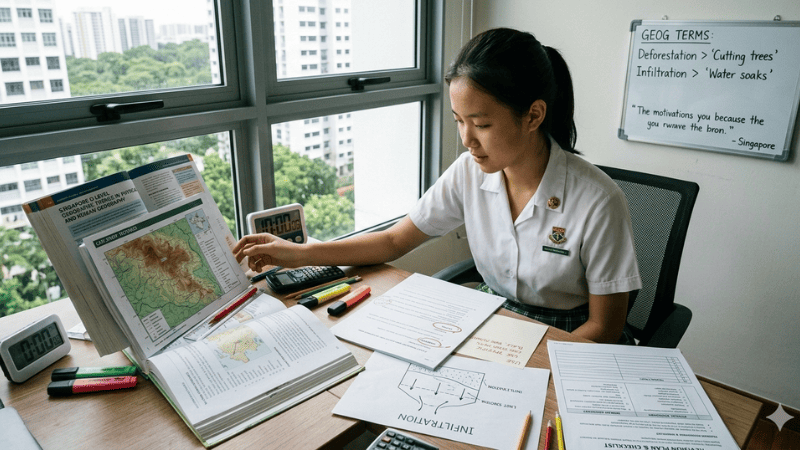
In scoring high marks, it is important to use proper geographical terms. Most pupils are well able to articulate concepts using simple vocabulary but often forget to use critical topic words. They can use the term “deforestation” instead of “cutting down trees”. For example they are supposed to write “infiltration” rather than saying that the water soaks into the ground. Proper use of words demonstrates greater insight and earns higher marks from examiners. Frequent updates to the main definitions and concepts may foster students’ confidence when using the right vocabulary.
Weak Map and Data Interpretation Skills
Geography tests are usually done on maps, graphs and data response questions. Students are not always able to explain changes and interpret trends correctly, nor do they know how to use appropriate phrases. As an example, they can write that numbers are increasing rather than saying that there is a progressive increase or a steep increase. Failure to read a map symbol correctly or to make incorrect distance calculations also results in marks being lost. These practical skills need to be enhanced through regular practice. Many students find that structured O level geography tuition provides focused training on map reading and data analysis, helping them avoid common errors.
Writing Too Much or Too Little
The other error is producing answers that are either too long and incoherent or too brief and underdeveloped. Other students end up repeating an idea using different words whereas others do not explain their points clearly. Answers to geography should be concise, well structured and to the point. Every paragraph must contain a definite point an explanation and where it is possible an instance. Well-considered responses that remain on point are bound to be rated high.
Not Practicing Past Papers
Many students do not pay much attention to reading notes and textbooks. But geography tests involve learning, not memorization. Unless they do past papers, students might not know how to answer questions or how they are marked. Past paper practice also helps students keep up with the usual types of questions and marking schemes. It also enables them to identify weak areas that require improvement. Learning platforms like GeoCafe encourage regular past paper practice so students can build exam confidence step by step.
Lack of a Structured Revision Plan
There are those students who revise haphazardly. They can simply concentrate on what they like and not on the hard parts like climate graphs, tectonic hazards, or indicators of development. This produces knowledge gaps. A carefully laid out revision schedule will ensure that everything is done. Balanced preparation can be ensured through dividing time between physical and human geography and reading weaker topics more frequently. Seeking additional support including O level geography tuition can also help students stay consistent and organized throughout their revision journey.
Conclusion
Geography is not a subject that can be memorized. The students should know how to ask questions and practice frequently. In most exam errors the cause is not a lack of intelligence but an inappropriate exam technique. The positive thing is that these errors can be fixed through enlightenment and hard work. With better preparatory measures and elimination of usual mistakes, students will have a tremendous opportunity to score very well in their geography exams.