
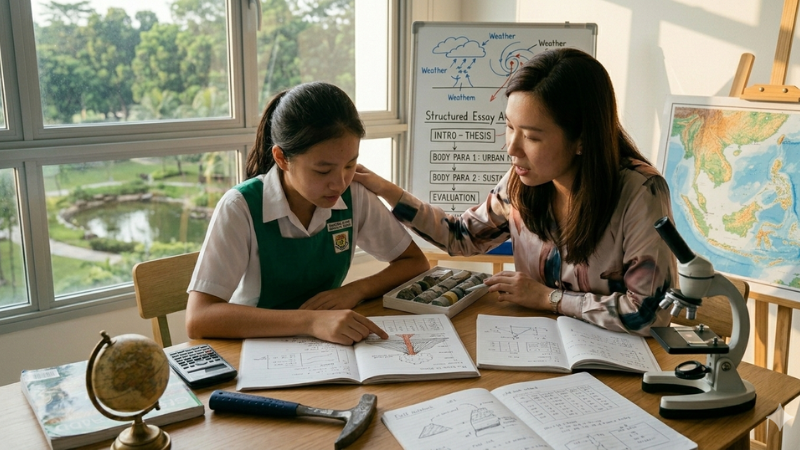

The secondary level of geography is no longer about memorising countries and capitals. Students are supposed to analyse data and write well-organised essays. Some areas such as climate change and globalisation require both critical thinking and good writing.
With the increasing academic standards most students struggle to maintain the pace and intensity of school lessons. The learning gaps can be overcome by adding academic support, enhancing comprehension and boosting performance. Here are the key benefits students gain from enrolling in Secondary Geography tuition.
Stronger Conceptual Understanding
Secondary Geography also presents complex processes in the physical and human world that need to be better understood. Students need to be able to know how things are interconnected how to recognize patterns and how to use theoretical information to apply to the real world.
In large classes the teachers tend to stick to a rigid timetable to cover the syllabus. Other students might require longer to understand some subjects yet they will not ask questions. Tuition provides a structured learning process in which concepts are progressively explicated through diagrams and laid out notes.
Understanding monsoon systems, urban planning and alleviating traffic congestion perfectly will equip students with chances to answer application based and data response questions in their examinations.
Individualised Care and Focused Change.
Each student has their own strengths and weaknesses. There are those who might not be good at reading maps and geography whilst others might have problems structuring their essays or remembering cases.
One major advantage of Secondary Geography tuition is personalised guidance. The lessons can be designed to address specific areas of weakness such as additional work with topographical maps or better evaluative writing.
Through focused exercises and instant feedback learners can easily correct errors and progressively improve. This individualised method guarantees gradual improvements rather than short-term enhancements prior to examinations.
Enhanced Exam Techniques and Structured Answering Skills
Learning content would not be sufficient to achieve high marks in Geography. Learners should learn how to read command words like describe, explain, analyse and evaluate. They should also be able to organize their answers within the time constraints.
A qualified Geography tutor teaches students how to break down questions effectively and plan answers logically. Students learn how to:
- Write strong introductions and clear topic sentences
- Use case studies accurately and strategically
- Apply geographical terminology precisely
- Provide balanced evaluations in higher-mark questions
Frequent exposure to exam style questions and marking schemes will help students get used to the examiners’ expectations. With time their responses become shorter and more effective.
Better Case Study Organisation and Recall
Case studies are a great component of Geography assessment at the secondary level in the UK. The students have to recall certain examples, statistics, effects, and reactions on a real-life event.
Unless the case study revision is properly organised, it may get out of control. Tuition also enables students to organize large amounts of information into coherent systems. They do not memorise paragraphs blindly but identify the major trigger points that can be used across various questions.
The strategic method enhances better memory of information and less stress during exams.
Improved Confidence and Academic Motivation
When students are consistently weak in a given subject they tend to lose confidence. They can start to think that they are just not good Geographers.
Tuition helps restore self faith through support and gradual progress. When the students start to learn something hard and their examination score starts improving, their motivation will also be boosted.
Confidence is a very important aspect of exam performance. When students are ready they tend to take higher-order questions, write more evaluative responses and spend their time well.
Structured Revision and Consistent Practice
Most students just start revising the evening before major exams. Geography however needs regular practice mastery of maps and writing essays.
With Secondary Geography tuition students follow a structured revision plan aligned with the school syllabus. The constant quizzes and time conditioned practices guarantee the year long reinforcement of learning.
Regular exposure eliminates cramming at the end of the semester and makes students have a greater long term retention.
Critical Thinking Skill Development.
Geography is a course that stimulates students to reflect upon issues about the world. Such problems as climate change and population growth need to be evaluated and analyzed in a balanced and multi perspective manner.
By applying facilitated discussions and organised questioning methods tuition honours analytical skills. The students are taught to evaluate both pros and cons, to prove the point with evidence and to make logical conclusions.
Such thinking abilities can be transferred and be useful to other humanities subjects as well.
Preparation for Higher Academic Levels
Geography is increasingly demanding as one progresses through upper secondary and beyond. Underlying weaknesses in the earlier stages may cause more problems in the later stages.
Structured support in the early stages would ensure that students develop solid fundamentals. It will have a solid academic foundation in future studies, owing to a clear understanding of physical processes, human systems, and evaluative writing techniques.
Those who understand the basic concepts at the initial stages are better positioned to perform well in higher subjects and tests.
Greater Awareness of Real-World Issues
Geography connects classroom knowledge to global events. Students get to learn about the dynamics of the world, be it natural disasters or urban planning strategies.
Examples of the present day and new case studies are usually included in tuition and this makes the lessons more interactive and relatable. The relationship between theory and reality improves knowledge and memory.
Final Words!
Geography in the secondary level involves analytical skills, organized writing and clarity of ideas. On the one hand, classroom training is the first step to knowledge; on the other hand, supplementary learning can be very effective in getting knowledge and improving performance.
The benefits include, but are not limited to, personalised attention and better exam strategies as well as better confidence and organised revision. With proper guidance students not only do better on tests but also acquire other important skills beyond tests.
Investing in Secondary Geography tuition can transform the subject from a challenging hurdle into a confident academic strength.