
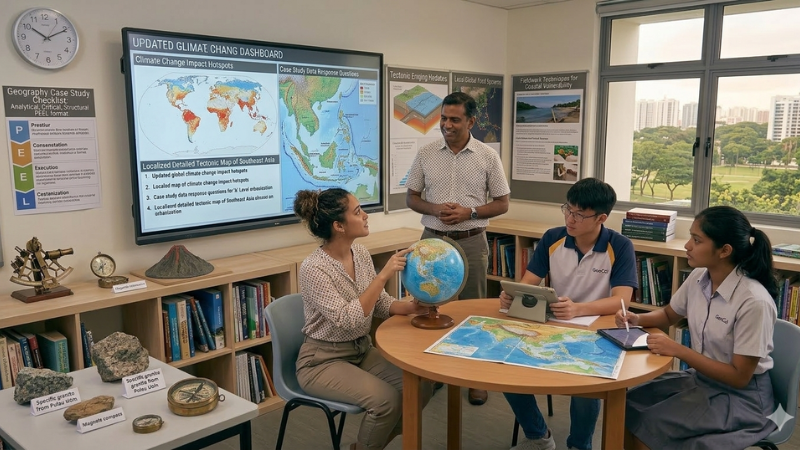
Passing Geography exams does not necessarily require studying a lot but presenting your answers in a good manner. It happens that so many students learn the material and fail to score due to poor organization of his/her answers and/or no examples given or even he fails to answer the question directly. Students can achieve a lot in enhancing their performance in exams by applying the correct techniques. The next guide is to describe how to use effective strategies to assist students in writing good and properly structured answers to the questions in the O Level Geography exams.
Understand the Question Carefully
The initial move towards writing a high scoring answer is to know clearly what the question entails. Most of the students are in a hurry to write without reading the question and in most cases offer incomplete or irrelevant answers.
There may be command words like describe, explain, compare, evaluate, or justify. All of these would need to be responded to in different ways. To give an example, the word, describe asks you to tell what you can see or know, but the word, explain does not ask this, but asks you to tell why or why.
The students are also expected to know the key focus and main topic of the question. Highlighting keywords can also be taken to make the answer remain within scope. Even 20-30 seconds of question analysis will not make it lose marks in the future.
Plan Your Answer Before Writing
Even a brief plan may render a significant difference in the articulateness of your reply. Do not rush out and write long paragraphs without first planning what to say.
For longer questions, jot down key points such as:
- Main idea or definition
- Two or three supporting points
- Examples or case studies
- A short conclusion if needed
Planning will allow you not to repeat yourself and will make sure you answer many points that are relevant. This is one of the most effective techniques taught in O level geography tuition programs because it helps students produce structured and complete responses under exam conditions.
Use Clear Paragraphs and Structure
Examiners like well written and readable answers. Do not write in a single huge paragraph. Rather, divide your answer into smaller paragraphs, which are directed towards one idea.
A strong paragraph usually includes:
- A clear point related to the question
- An explanation or description
- A supporting example
As an example, when posed a question regarding the causes of flooding, a paragraph can be devoted to the excessive rain and another paragraph will be devoted to deforestation. This will make examiners pinpoint the main aspects of the work and mark the points in an effective manner.
Include Relevant Examples
It is always advisable to involve case studies, places, or real events. To take a case in point, speaking about earthquakes, you can speak about a certain country or incident. This is a show of more in-depth insight and builds your response to be more credible.
Whenever possible, include case studies, places, or real events. For example, when discussing earthquakes, you might mention a specific country or event. This demonstrates deeper understanding and strengthens the credibility of your answer.
Students who attend O level geography tuition often practice using case studies regularly, which helps them recall examples more easily during exams.
Use Geographical Terms Correctly
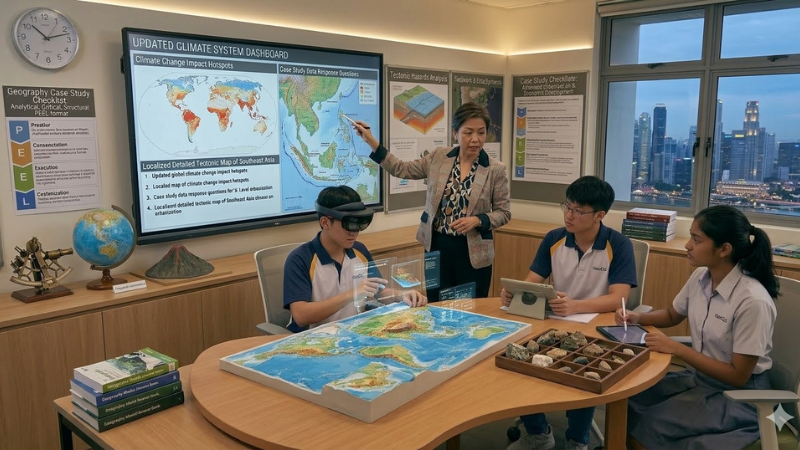
Geographical vocabulary can help you get better answers through the correct use of geographical vocabulary. This is because words like erosion, urbanization, tectonic plates, population density and climate change need to be properly used where they are applicable.
Nevertheless, do not complicate your responses too much. This is not to use complicated language but to express your thoughts in an understandable and precise manner.
One of the methods is to describe the main terms using a few lines and then use them in your description. This is comprehensive and lucid.
Support Your Points with Explanations
Many students lose marks because they list points without explaining them. Geography exam questions often require not just identification but reasoning and analysis.
For example, instead of writing:
“Deforestation causes flooding.”
A better answer would be:
Deforestation also exposes people to floods since the trees usually absorb the rain and maintain the soil. Removal of forests leads to a large amount of water reaching rivers, which is highly likely to cause floods.
Such explanation level exhibits better knowledge and can guarantee better results.
Manage Your Time Wisely
The skill of time management is very important in exams. Other students take too much time on a single question and hurry up on the rest of the answers.
The best tactic that can be employed is to divide time depending on the marks per question. As an illustration, when a question is worth 6 marks, it should not require the same duration as a question that is worth 12 marks.
Timing can be best practiced by doing past papers. Systems such as Geocafe can offer useful resources, instructions, and organized practice that enable the students to make simulations of real exam conditions and improve their answering methods.
Use Diagrams and Maps When Helpful
Geography is a graphic subject and in some cases the diagrams may explain better than the lengthy descriptions.
For example, students may draw simple sketches to show:
- River features
- Plate boundaries
- Urban land use models
- Coastal processes
These figures need not be flawless, though they must be understandable, marked and applicable. A little drawing with a brief description can underpin an answer in a much greater way.
Many teachers in O level geography tuition classes encourage students to practice drawing quick and simple diagrams because they save time while improving clarity.
Avoid Common Mistakes
To maximize marks, students should also avoid several common mistakes:
- Writing irrelevant information that does not answer the question
- Repeating the same idea multiple times
- Forgetting to provide examples
- Writing extremely short answers for high-mark questions
- Ignoring command words such as “explain” or “evaluate.”
Students need not lose easy marks by being distracted by the question and giving vague explanations.
Practice Regularly
To raise grades in exams, one needs to practice. However, it is important to read textbooks, but to train students to write answers under timed conditions.
Regular practice helps students:
- Develop a faster writing speed
- Improve answer structure
- Remember case studies more easily
- Gain confidence before exams
Online learning sites such as Geocafe may come in particularly handy since they offer systematic learning resources and instructions that can enable students to master their examination strategies step by step.
Final Thoughts
An ability to write high scoring Geography answers is one of the skills that can be perfected through practice, planning and with proper guidance. Proper interpretation of questions, clear organization, examples and clear explanation of points can help the students to score a lot more in their exams.
With consistent effort and the right support, mastering Geography exam writing becomes much easier, allowing students to demonstrate their knowledge confidently and achieve strong results.