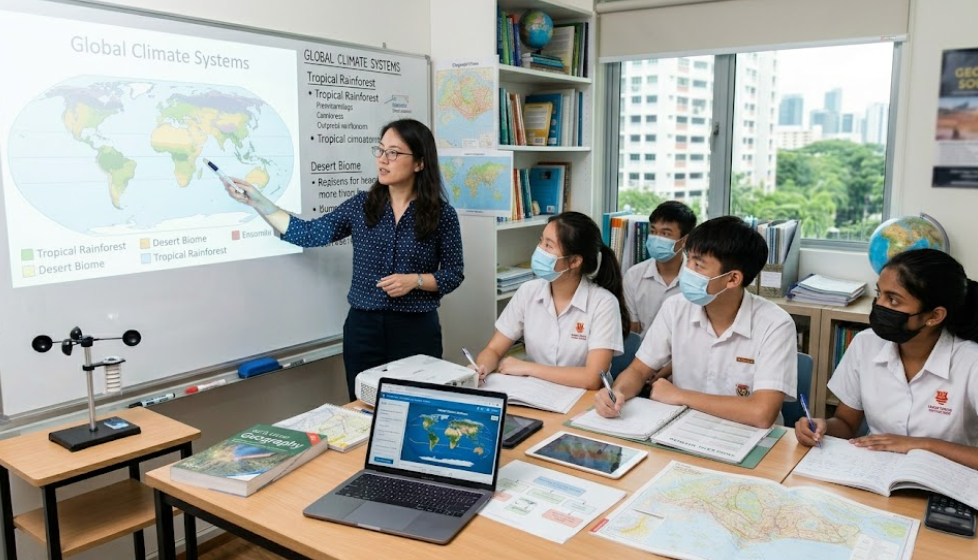
Geography is a wonderful subject because it enables students to gain insight into the world they live in. It covers a wide range of topics, from natural landscapes, climate systems, world population to cities and urban development. Many struggle with the subject as it is a mixture of remembering facts and case studies; using and understanding maps; collecting, displaying and analyzing data and written extended answers. When exams are looming, students find themselves revising everything endlessly but may not gain the marks they desire.
It’s not rarely lack of hard work. The main cause is that students tend to revise in ways that do not suit the subject. In geography, there should be a good revision technique based on knowledge, its application, and exam skills. With the help of JC Geography tuition, students can revise better and score higher too.
Understanding How Geography Exams Work
Before planning a revision, students should know what the Geography exams aim to test. The examiners are not testing on memorized definitions and facts. Rather they are testing whether students can explain what they know, compare information, analyse evidence and reach logical conclusions.
This implies that going through the revision is not equally important. Students should learn the processes and memorize the examples, as well as, practice answering exams questions. Giving a glance to the notes several times, is just not enough.
Attending JC Geography tuition helps students understand what is required in the exam. They are also taught to organize their revision around the most critical skills.
Focus on Understanding Before Memorization
The worst mistake students can make is learning things off by heart before fully understanding the subject. Geography can be full of links between loads of different ideas. Knowing these links makes second time going over the material easier and faster.
In the case of climate change, for example, one can turn to general knowledge of its causes, effects, and potential ways to avoid it, rather than trying to memorize facts in bits and pieces. The key concepts put knowledge into context, making it easier to recall.
Students should ask questions such as:
- What is the reason for this?
- What are the impacts on people and the environment?
- What are some references for this?
- On what types of questions will examiners assess this topic?
This helps students achieve a deeper understanding and retain information for longer.
Create a Structured Revision Plan
A number of students start revising without any definite plan of what they want to cover, and then get confused. Geography provides a large amount of information to remember and revise, and trying to go over the whole lot in one gulp can be very disappointing.
Maintaining a fixed revision timetable can keep you organized and make sure you have covered everything. Divide your revision into chunks and set an intention for each session.
For example, a practitioner’s spatial focus may be one session on the physical geography of rivers or coasts and another on topics in human geography, such as urbanization or population change.
A good revision timetable will also help students stay consistent, which is often more productive than studying for long periods.
Use Maps, Diagrams, and Visual Learning Techniques
Geography is a very visual subject. There are often many things better understood through maps, diagrams, photographs, and infographics than through the written page.
Students should incorporate visual learning techniques into their revision by:
- Practicing map-reading skills regularly
- Drawing diagrams from memory
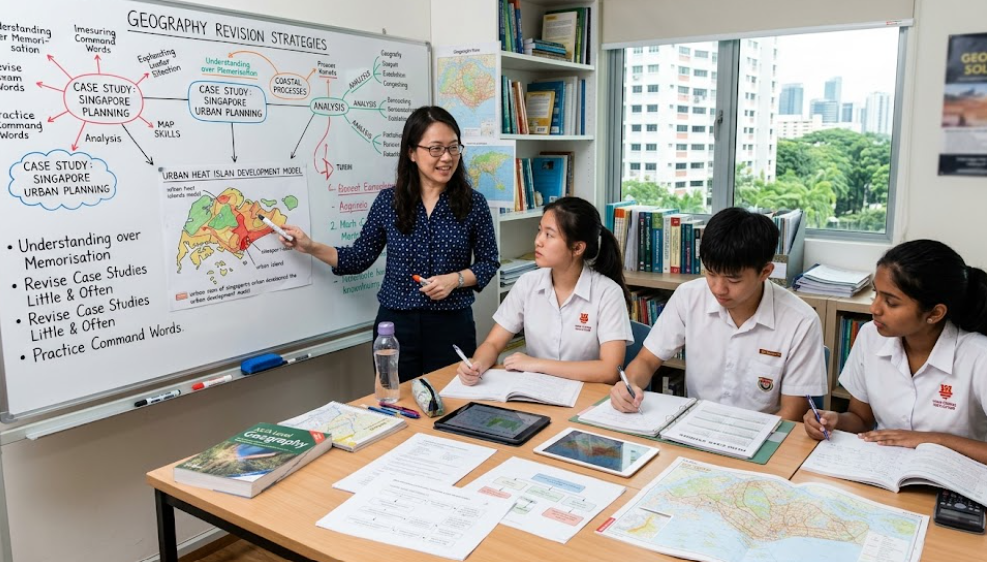
- Developing mind maps on primary themes.
- Flow charts for reporting geographical processes
- Examining geographical case studies with diagrams
Visual revision techniques support students in retaining information more permanently and sharpen their skills of how to read maps during an exam.
Make Case Studies Easier to Remember
Case studies are often asked in Geography exams and it is often the one part students can have trouble remembering due to its length. The trick is not to memorize pages of facts, but to concentrate on highlights.
Students should identify:
The location
- Key facts and statistics
- Causes of the issue
- Effects on people and environment.
- Management strategies or solutions
Writing summaries, by condensing information into easy to memorize summaries, will help students retrieve info from case-studies during exams. Briefly reviewing case-studies frequently also helps combat fading.
Students having JC Geography tuition are becoming increasingly proficient at memorizing the examples needed without feeling bombarded by too much information.
Practice Exam Questions Regularly
One of the most efficient methods of revision is to attempt exam questions under exam conditions. Often students know their material but have difficulty applying it at exam time.
Practicing past papers, students learn the types of questions you are likely to get, the command words, and marking schemes. This allows them to work out what to include in top mark answers.
- Regular practice also helps students:
- Improve time management
- Develop stronger answer structures
- Identify knowledge gaps
- Build confidence before exams
With more practice, students become more confident in using their geographical knowledge in the exam.
Learn How to Evaluate and Analyze
Questions in advanced Geography tend to demand several words or a paragraph of detailed description. Often students are asked to:
distinguish and provide information
contrast two perspectives
judge the success or failure of a solution.
Training in: How to argue objectively or how to list the pros and the cons and focus on one side at a time or to consider other points of views and back up arguments with proof.
For instance, if the question relates to flood management approaches, students should not just state what has been implemented. They should argue on how a good of effect was achieved, indicate shortcomings and give reasons for their judgement.
By honing these analytical skills, students can greatly enhance their performance in exams and reach higher scores.
Revise Little and Often
Too often students procrastinate revising and try to review far too much material in far too little time. This is a recipe for disaster!
Studies have repeatedly shown how good distributed revision is (The Sooner the Better). Regular smaller chunks of revision will help reinforce the learnt material into Long term memory.
It is preferable for a student to revise their work several times during the school year rather than solely before exams. Small, easier revisions can be very effective when performed regularly.
This technique not only enhances retaining information but helps combat stress when taking an exam.
Seek Expert Guidance When Needed
At times, students may appear to work even harder and longer, but still encounter excessive difficulties. Extra help can be a real godsend in those cases.
Trained and experienced tutors will be able to identify question pitfalls and challenging ideas; and will be able to discuss individual revision methods to suit each student. Good tutors can give useful feedback on exam technique and how to approach answer questions.
With JC Geography tuition, students are given the right attention so they can learn more effectively, revise more efficiently, and build a stronger foundation in the subject. Generic practice and guesswork are replaced by expert help.
Conclusion
To improve Geography exam performance, successful revision is not the most hours spent revising. How you revise is what makes the difference. Knowledge of the subject, planning your revision, visual methods of revising, practicing exam questions and regularly revising all does work.
Geography is a subject that can be easily mastered if carefully studied and analyzed. By revising systematically, students tend to perform better and maintain confidence throughout their revision. With the effective revision techniques taught at JC Geography tuition, students can generally approach their exam with greater confidence.